
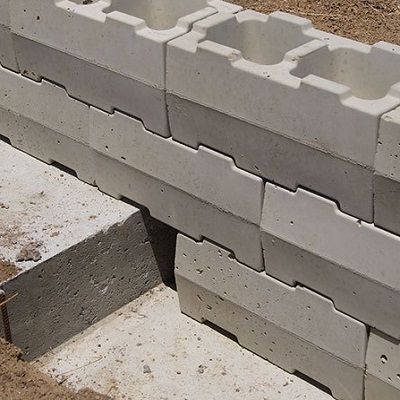
 Performance and Specifications of Lego Concrete Blocks
Interlocking concrete building blocks are stronger, faster to use and more cost-effective for building.
Interlocking concrete building blocks are ideal for the building of perimeter walls, boundary walls, warehouse walls, factory walls, storerooms, cottages, retaining walls, homes, houses, farm ponds, sheds, French drains, septic tanks, shuttering of concrete columns, swimming pools, etc.
Each block is strong with a compaction strength of over 7 MPa. MPa is the compression strength of concrete.
MPa stands for megapascals (a measure of pressure).
1 megapascals = 10.19 (145.03 pounds per square inch) kilograms-force per square centimeter.
This means that compaction strength of over 7 MPa is equivalent to a strength of 71.38 kilograms-force per square centimeter (1,015.26 pounds per square inch).
Advantages of Using Interlocking Concrete Hollow Building Blocks
- Blocks can be made and built with unskilled labour after basic training (only limited training is required).
- From a solid and level foundation construction can be achieved with unskilled labour.
- The only tools required for making a block are a shovel (for mixing) and a builder’s trowel (for finishing).
- A 2m x 2m soak away can be constructed by dry stack and operational within 30 minutes.
- Interlocking hollow blocks are glued together by dipping the base of each block with thin-bed mortar making building ten times faster.
- Construction method saves at least 40% to 50% compared to similar construction costs.
- Columns built using interlocking hollow blocks and subsequently filled with concrete can be built at 30% of the normal cost.
- No lintels are required for standard openings i.e. doors & windows.
- Interlocking hollow blocks cavities may be used for pipework/electrics and/or filled in with a suitable insulation material e.g. foam/granules.
- Interlocking hollow blocks constructions are immediately load-bearing i.e. for roof/support/concrete deck.
- Minimal sand – only in the foundation and no need for Plaster.
- Minimum cement at joints only.
- Sturdy and Aesthetic Look.
- Blocks are reusable when removed carefully.